
Can I Use My 529 Plan for Off-Campus Housing?
Your student got accepted, signed a lease, and moved into an apartment near campus.
Now rent is due every month.
And a familiar question shows up:
"Can I use my 529 plan to pay for this?"
The short answer is yes.
But off-campus housing is one of the most misunderstood areas of 529 plans — and one of the easiest places to make a mistake that only shows up at tax time.
I learned some of this the hard way with my own daughter.
Let's walk through how it actually works so you don't have to.
The Short Answer
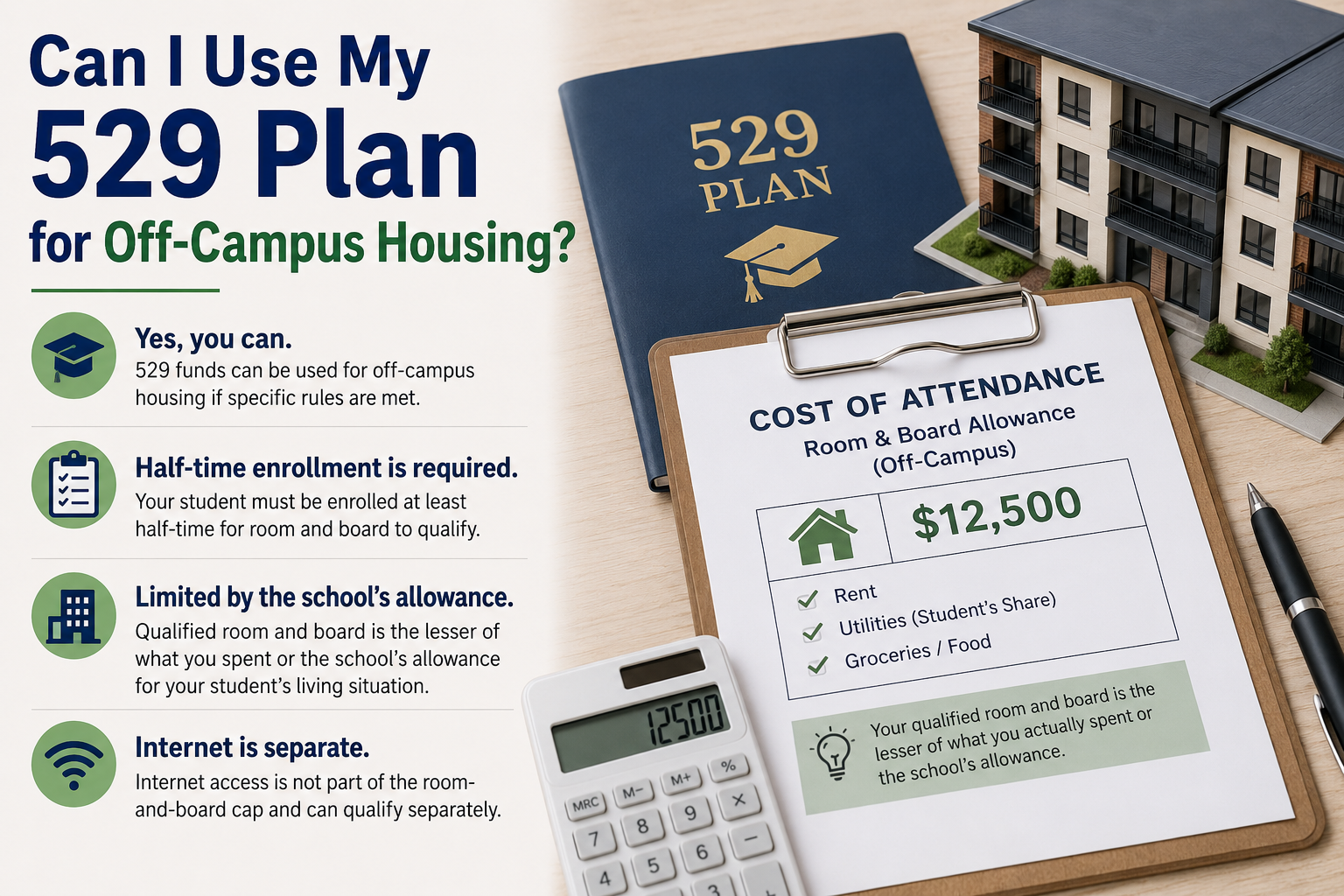
Yes, you can use a 529 plan for off-campus housing.
But only if a few conditions are met.
Your student must be enrolled at least half-time. The expenses must qualify as room and board. And most importantly, the total amount you treat as qualified is limited by a number set by the school.
That last part is where most families get tripped up.
The Rule That Comes Before Everything Else
Before you count a single dollar of rent, your student must be enrolled at least half-time.
This is not a flexible guideline. It's a hard requirement.
If your student drops below half-time enrollment for a period, room and board expenses during that time generally do not qualify for tax-free 529 treatment.
That applies regardless of where they live or what the lease says.
So before anything else, confirm your student meets the half-time requirement.
How Off-Campus Housing Actually Works
Here's the part that surprises most families.
When your student lives off campus, qualified room and board is limited to a specific amount determined by the school. This number is part of the school's published Cost of Attendance.
Not your actual rent.
Not what the apartment costs.
The school's allowance.
The rule is straightforward once you see it clearly:
Your qualified room and board is the lesser of what you actually spent or the school's allowance for your student's living arrangement.
If your rent and food costs come in below that number, you can use what you actually spent.
If your costs exceed it, the excess is not a qualified expense — even though you really paid it.
That difference is where mistakes happen.
Why Room and Board Feels Different
Most education expenses don't work this way.
Tuition, for example, is not limited by the school's Cost of Attendance estimate. If tuition and required fees are necessary for enrollment at an eligible school, they can qualify without being capped by that estimate.
Room and board is different.
Among the common college expenses, it is unusual because it is specifically limited by the school's allowance.
Once you understand that distinction, the rest of the rules start to make more sense.
The Number That Determines Everything
Every school publishes a Cost of Attendance, often referred to as COA.
Within that COA is a room-and-board figure, and most schools break it out by living situation:
On campus
Off campus
Living at home
If your student lives off campus, the off-campus room-and-board allowance is the number that matters.
This number is not always easy to find.
Some schools publish a clear table or PDF. Others require you to navigate calculators or financial aid tools that are less obvious.
If the website isn't clear, go directly to the financial aid office and ask for the off-campus room-and-board allowance for your student's situation.
Once you find it, save a copy.
That number is the ceiling that determines how much of your housing expense can be treated as qualified.
What "Room and Board" Includes
For an off-campus student, room and board generally refers to the student's housing and food costs.
In practice, that usually includes:
Rent
The student's share of housing-related utilities
Groceries or other food expenses
The IRS does not provide a detailed item-by-item list of what qualifies in this category. Because of that, it's important to keep records that show the expenses were genuinely for housing or food.
All of these costs are combined under a single limit.
That's an important point.
If rent alone uses up the full allowance, adding groceries or utilities on top does not increase the amount you can treat as qualified. Everything is working within one ceiling.
Internet Is Treated Differently
There is one important exception that often gets missed.
Internet access is treated separately from room and board.
IRS rules specifically include internet access and related services as a qualified education expense when used primarily by the student during a year in which they are enrolled at an eligible school.
That means internet is not part of the room-and-board cap.
Even if your rent already reaches the school's allowance, internet may still qualify separately.
Just keep in mind that the expense should be attributable primarily to the student.
A Simple Example
Let's make this concrete.
Assume your student's school publishes an off-campus room-and-board allowance of $12,000 for the academic year.
If your student's total housing and food costs come to $10,000, you can treat $10,000 as qualified.
If those costs come to $15,000, you are still limited to $12,000.
The extra $3,000 does not qualify.
If you withdraw that extra amount from the 529 plan anyway, a portion of the earnings associated with that distribution may become taxable and could be subject to an additional 10% tax.
That's the trap.
The Summer Lease Problem
Most off-campus leases run for twelve months.
The school year does not.
This creates a gap that many families don't think about until later.
Room-and-board expenses qualify only during periods when the student meets the half-time enrollment requirement. That means summer housing may qualify if the student is enrolled at least half-time during a summer academic period.
If the student is not enrolled at least half-time during that period, housing costs associated solely with that time generally should not be treated as qualified room-and-board expenses.
There isn't a universal answer for which months qualify. It depends on your student's enrollment and the school's academic calendar.
The safest approach is to match housing costs to the periods when your student actually meets the eligibility requirements.
Splitting Rent With Roommates
If your student shares an apartment, the principle stays the same.
You can only count the portion of the expense that applies to your student.
If the rent is split between roommates, you should be able to show your student's share. The same applies to utilities and other shared costs.
Documentation is what turns a reasonable assumption into a defensible position.
Costs That Generally Do Not Qualify
Not every expense tied to off-campus living counts as room and board.
Costs that generally are not treated as qualified room-and-board expenses include:
Furniture
Moving expenses
Renters insurance
Late fees
And any amount above the school's allowance does not qualify, even if it's clearly part of your student's actual cost of living.
Just because a cost comes with living off campus doesn't mean it fits within the IRS definition.
A Note on Timing
529 plans operate on a calendar-year basis for tax purposes.
That means distributions and qualified expenses are ultimately coordinated within the same tax year.
However, the room-and-board limit itself is based on the student's academic period and living arrangement.
If your student's housing situation or enrollment changes during the year, those differences matter.
At tax time, everything comes together for the year, but the underlying limits still depend on the specific academic periods involved.
What I Learned the Hard Way
When my daughter first moved off campus, I assumed her rent was simply a qualified expense.
She was in college. She needed somewhere to live. It felt obvious.
It wasn't.
Her rent exceeded the school's room-and-board allowance, which meant part of what we were paying never qualified for tax-free treatment.
I also wasn't accounting for internet as a separate qualified expense, even though it was eligible the entire time.
And early on, I was tracking everything in detail without realizing that once rent exceeded the allowance, much of that extra tracking didn't change the outcome.
Saving the money and using the money correctly turned out to be two very different challenges.
Expert Tip
Get your school's off-campus room-and-board allowance in writing at the very start of each academic year — before you set your housing budget.
Allowances change from year to year and differ by school and living situation.
That one number tells you exactly how much of your rent the tax-free way can actually cover, and it protects every withdrawal you make afterward.
Common Mistake
The most common off-campus housing mistake is simple:
Families withdraw their actual rent instead of the school's allowed amount.
When the real rent is higher than the published allowance, the difference can quietly turn into a taxable withdrawal.
Always compare your actual housing costs to the school's published allowance before you withdraw.
IRS Reference
The information in this article is based primarily on IRS Publication 970, Tax Benefits for Education.
Because tax laws change and some situations require interpretation, consult the current IRS guidance or a qualified tax professional for advice specific to your circumstances.
How 529 Tracker Helps
Off-campus housing is exactly the kind of expense 529 Tracker was built to handle.
It's not a receipt-storage app. It's a complete record-keeping and decision-support system for your qualified education expenses.
For your housing costs, you can:
Keep your school's published room-and-board allowance on hand, so you always know your ceiling
Record rent, utilities, groceries, and internet as you pay them — or total them once at the end of the term
Attach receipts and lease documents to every entry
Assign each expense to the correct student and academic term
See at a glance how your actual spending compares to the school's allowance
Know your remaining tax-free withdrawal amount before you withdraw, not after
Walk into your tax appointment with a complete, exportable record
Instead of guessing at the allowance during tax season, you'll have the number — and the proof — ready.
Related Articles
What Can a 529 Plan Actually Pay For?
Room and Board Rules Explained
How Scholarships Affect 529 Withdrawals
Common 529 Mistakes That Cost Families Money
How to Track 529 Expenses by Calendar Year
Final Thought
Off-campus housing can absolutely be paid for with your 529 plan.
But the key is understanding the limit, staying within it where you can, and keeping the records to support it.
That's what protects the tax-free benefit you spent years building.
A few minutes of clarity now can prevent a much bigger problem later.
This article provides general educational information and is not tax, legal, or financial advice. Calculations and projections depend on the information entered and are estimates rather than guarantees. Rules and individual circumstances vary, so families should review current IRS guidance and consult a qualified professional when appropriate.